Across Africa, including Tanzania, significant investments have been made in girls’ education. Scholarships are awarded. School materials distributed. Mentorship programs launched.
And yet, girls continue to drop out.
Why?
Because education does not exist in isolation.
The Lesson I Learned at Home
I know this not only as a practitioner, but from lived experience.
I was raised by a single mother surviving on less than $2 a day. School fees were only one part of the struggle. There were days when food insecurity, social pressure, and economic uncertainty shaped every decision in our household. Education mattered deeply — but survival often came first.
That experience shaped how I see girls’ education today. And it is the foundation on which Girls First Initiative was built.

The Myth of the Scholarship-Only Model
Many organisations focus on paying school fees. This matters — but it is rarely enough on its own.
A girl may have her fees covered and still:
- Walk through unsafe neighbourhoods to reach school
- Face harassment on public transport
- Experience pressure toward early marriage driven by household poverty
- Have no safe way to report abuse
What our work has consistently revealed is that dropout is almost never about a family not valuing education. It is about survival trade-offs. When a household is under economic stress, every decision — including whether a child stays in school — gets filtered through the question of what the family can afford, in every sense of that word.
A scholarship addresses one variable in a deeply interconnected system. The system itself has to shift.

A Different Model: The 360° Ecosystem Approach
At Girls First Initiative, we believe that for a girl to access and complete quality education, she must be supported by a stable household and protected by a safe community. These are not supplementary conditions — they are foundational ones.
In 2025, we piloted this belief.
The Pilot: What We Did
Over the course of the pilot phase, we supported:
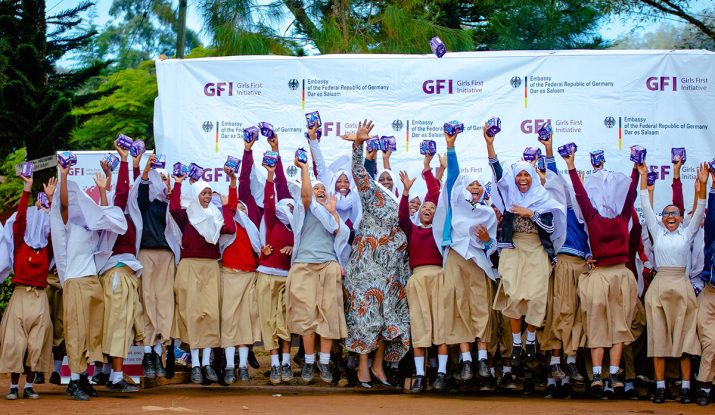
- 50 girls with scholarships, mentorship, and life skills training
- 100 families through economic strengthening and structured engagement
- 20% of those families with seed funding to launch or expand income-generating activities
- 100 community actors — including local leaders and public transport providers — with training on safeguarding and girls’ rights
This was not about scale. It was about proof of concept: could shifting the environment around a girl change what was possible for her?

Three Pillars, One Ecosystem
1. Supporting the Girl: Building Agency, Not Just Access
Each girl in the pilot received educational support (including school contributions and materials such as uniforms and books), mentorship, leadership training, and safe spaces for open discussion. The goal was not only to keep girls in school — it was to build the kind of confidence and self-knowledge that sustains them through the pressures they face outside the classroom.
We observed that her growth accelerated when her environment shifted alongside her.
2. Strengthening the Family: Addressing the Root Cause
We engaged families not as beneficiaries, but as partners. Through income-generating skills training, financial literacy sessions, and structured conversations about education as investment, caregivers began to reframe what school meant for their daughters — and for their households.
Families who received seed funding were selected based on need and readiness. These were not large transfers. But at the right moment, they reduced the financial pressure that had been driving difficult decisions at home.
The result was quieter but significant: less tension around schooling, more parental engagement, more openness about a daughter’s future.
When caregivers gain economic stability, girls gain psychological safety.
3. Transforming the Community: Creating a Protective Environment
We trained 100 community actors — including boda boda riders and public transport leaders — on safeguarding, girls’ rights, and accountability.
The choice to focus on transport providers was deliberate. Girls do not only exist in classrooms. They move through public systems every day, and those systems shape their safety and their sense of what is normal. By engaging the people who interact with girls in public spaces, we began shifting community responsibility — from passive observation to active protection.
Early feedback showed increased willingness to report and address harassment. A small shift, but a meaningful one.
What the Pilot Confirmed
Poverty is structural, not personal. Families do not fail their daughters. They lack capital, opportunity, and institutional support. When equipped with tools and trust, caregivers become advocates — not obstacles.
Small economic interventions create large emotional shifts. Reducing household financial stress changes the atmosphere in which a girl does her homework, eats her meals, and imagines her future.
Community actors are hidden gatekeepers. Transport providers, local leaders, and informal influencers shape girls’ daily safety in ways that schools and scholarships cannot reach. Engaging them is not peripheral — it is structural.
Ecosystem change is preventative. When economic empowerment and community safeguarding happen together, vulnerability and dropout risks decrease before a crisis emerges — not in response to one.

Looking Ahead
Fifty girls may seem like a small number. But behind each girl is a family, a set of community norms, and a web of systems that will either support or undermine her.
By engaging 100 families and 100 community actors alongside those 50 girls, we tested what we believe is a more honest model of girls’ education — one that addresses root causes rather than symptoms, and builds conditions that last.
My life could have looked very different if my mother had received economic support alongside my education. Through Girls First Initiative, we are building the model I wish had existed when I was that girl.
Because a scholarship is powerful. But stabilising her household and transforming her community is what makes that scholarship mean something. And when we do that, we do not just change one girl’s life — we interrupt a cycle.
Girls First Initiative (GFI) is a Tanzania-based organisation working to ensure girls access and complete quality education through a 360° ecosystem approach, supporting girls, strengthening families, and transforming communities.
If this model resonates with you — as a funder, partner, policymaker, corporate, or advocate —we would like to hear from you.
You can read more about our work Here