What the first Binti Kinara cohort in Kibwegere taught us about economic empowerment
For a young woman in Tanzania, the transition from late adolescence into adulthood is often marked not by a clear path of opportunity, but by a series of quiet compromises. When formal education ends—whether due to financial constraints, family expectations, or systemic barriers—the safety net disappears. For those aged between 18 and 27, this out-of-school period is a critical juncture. Without institutional support, many find themselves navigating an informal economy with high aspirations but limited structural pathways.
At Girls First Initiative (GFI), we have long understood that supporting these young women requires looking at their lives holistically. Our work is anchored in three interconnected pillars: **Her Education, Her Health, and Her Economy**. We know that a young woman cannot fully participate in her community’s economy if her health is compromised, nor can she protect her health and bodily autonomy without the agency that economic independence brings.
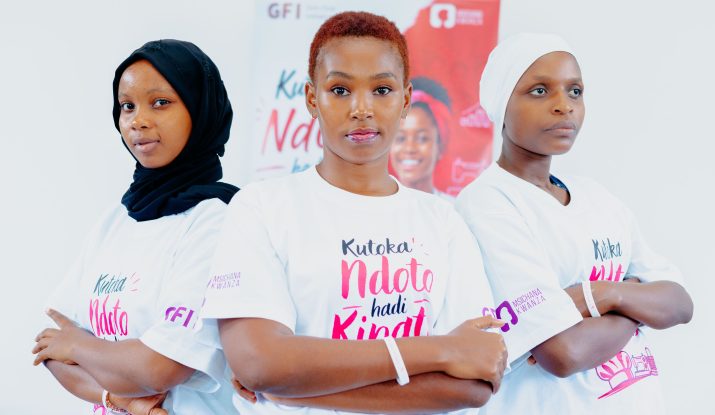
It was this foundational belief that birthed **Binti Kinara** (meaning “Heroine” or “Leading Daughter”), a specialized program designed under our *Her Economy* pillar. Carrying the theme *Kutoka Ndoto Hadi Kipato* (From Dreams to Income), Binti Kinara was built to walk alongside out-of-school young women as they transition from dreaming of financial stability to actively building it.
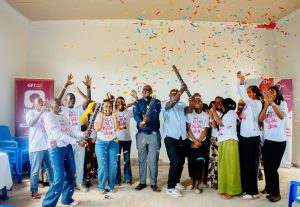
Recently, we concluded our inaugural cohort training phase in Kibwegere, located in the Kibamba Ward of Dar es Salaam. The journey of those two weeks offered profound insights into what it actually takes to foster sustainable livelihoods for young women in rural and peri-urban Tanzania.
What’s in a Name: Why “Kinara”
Kinara means beacon, or lighthouse. We didn’t pick it by accident. For the 30 women in this first cohort, the idea was that the programme should work the way a lighthouse does — not doing the sailing for anyone, just giving a fixed point to steer by in waters that are genuinely hard to navigate on your own: informal trade, thin margins, and markets that shift under you without warning.
It’s a small detail, but it tells you something about how GFI thinks about this work. We’re not trying to hand these women a finished business. We’re trying to give them something steady to orient around while they build their own.
Meeting the Entrepreneurs of Kibwegere
There’s a common assumption in youth unemployment conversations — that young people are waiting around for someone to hand them a reason to get started. Our experience in Kibwegere completely disproved this assumption.
Of the 30 young women who gathered for the Binti Kinara program, 19 were already running micro-businesses. They were selling vegetables, managing small retail stalls, trading fabrics, or running modest beauty spaces. They did not need GFI to teach them ambition. They were already working, navigating volatile market prices, and managing household responsibilities simultaneously.
| BINTI KINARA AT A GLANCE — KIBWEGERE COHORT | |
| Participants | 30 young women, ages 18–27 |
| Already running a business | 19 of 30 |
| Format | 2-week intensive, 6 sessions |
| Pillar | Her Economy |
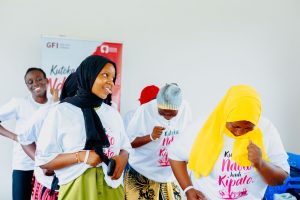
What they didn’t have was structure, coaching, or a network they could actually lean on. So for two weeks, meeting every Monday, Wednesday, and Friday, these 30 women stepped away from their businesses and households to invest time in themselves. The sessions were built around their real challenges, not a generic syllabus.
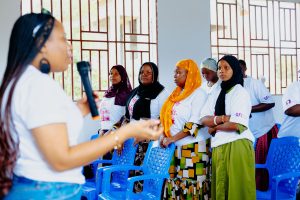
A Curriculum That Goes Past the Business Plan
Most entrepreneurship training in this sector stays close to the mechanics: write a plan, track your margins, find customers. Binti Kinara covers that, but we built it around three cores that work together rather than one.
- The Personal Core: Alongside business logic, we integrated modules on personal leadership, building an entrepreneurial mindset, confidence, and self-agency.
- The Business Core: Participants learned human-centered design, customer-focused innovation, business idea validation, implementation planning, record-keeping, marketing, and customer service. They analyzed why some businesses grow while others plateau.
- The Safety and Well-being Core: Crucially, the program integrated sessions on Sexual and Reproductive Health and Rights (SRHR), personal safety, and mental well-being.
| PERSONAL CORE
Leadership · Agency · SRHR · Personal Safety |
↓
| BUSINESS CORE
Human-centred design · Financial literacy · Business systems |
↓
| SUSTAINABLE LIVELIHOOD |
Why put SRHR and personal safety inside a business programme at all? Because a young woman’s business doesn’t exist apart from the rest of her life. Gender-based violence at home affects her business. Losing control over her reproductive choices can cut a career short before it starts. Harassment in the marketplace puts her income at direct risk.
Entrepreneurship and personal safety belong in the same conversation. Economic empowerment requires protecting what young women build. We cannot talk about business growth if we are not also talking about the physical, emotional, and social safety of the woman running that business.
— Bahati Mgogwe, GFI Executive Director
Capital Is Fuel, Not the Engine
The programme closed with every participant presenting a business plan — for many, the first time they’d put their idea on paper: target market, costs, growth. From those plans, 11 participants received TZS 200,000 each in seed funding for the strongest, most workable proposals.
We’re wary of a common trap in this sector: treating a grant disbursed as a problem solved. Capital helps, but on its own it rarely produces lasting change.
So the classroom closing wasn’t the end of anything. All 30 participants — funded or not — moved straight into GFI’s mentorship ecosystem: peer circles, regular check-ins, coaching. The funding is the catalyst. The mentorship is what keeps the business standing a year from now.
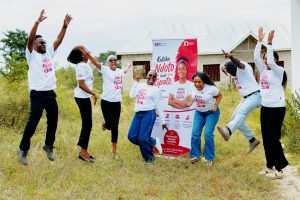
Four Things Kibwegere Taught Us
This first cohort is already shaping how we’ll design Binti Kinara going forward.
1. Capital matters. Capabilities decide who survives.
A woman with TZS 200,000 and solid record-keeping habits will outlast one with double the capital and no read on her own cash flow. It’s the combination that matters, not the cash alone.
2. The drive was already there.
Nobody needed to be taught to want a better life. You could see it in how these women ran their households, raised their kids, kept their businesses moving, and still showed up to every session on time. Our job isn’t to manufacture ambition — it’s to clear the structural barriers in front of it.
3. This doesn’t work without the community.
Programmes that get dropped into a community from outside tend to fail. We involved local leadership from day one — the Kibamba Ward Councillor, the Kibwegere Street Chairperson, the Street Executive Officer, and community members were at both the launch and the graduation and the Street Government was directly involved in the selection of the beneficiaries on a needs based criteria. When local leaders back this kind of work, they end up protecting these businesses and the women running them long after GFI’s direct role.
4. Without financial literacy, revenue and cash get mixed up — and the business quietly loses.
Several participants told us, mid-session, that they’d been running their business money and household money through the same pocket. That makes it almost impossible to know if you’re actually turning a profit. A few basic record-keeping habits changed that immediately — several women said they could see their cash flow clearly for the first time, seed funding or not.
Two more things came up consistently that are worth naming. Peer support cut down on how isolated informal trade can feel — the women used the group to trade notes on suppliers, difficult customers, and safety concerns, and that network is its own kind of capital. And confidence showed up before income did: the sessions on leadership and agency translated fast into how participants negotiated with suppliers and priced their own work.
| KUTOKA NDOTO
The Dream: aspiring out-of-school young women |
BINTI KINARA
The Ecosystem: training, SRHR, mentorship |
HADI KIPATO
The Income: sustainable, safe, independent livelihoods |
Looking Ahead
The pilot has held up. The Guardian (Tanzania) covered it under the headline “Programme builds entrepreneurial skills to boost economic independence among young women.” That’s a nice thing to see, but the real read on whether this worked is in the ledgers these women keep now, not the coverage.
We don’t see Binti Kinara as a one-off. It’s a model we want to run in other wards and regions, because the barriers these 30 women faced in Kibwegere aren’t specific to Kibwegere. Support a young woman’s business, her health, and her right to make her own decisions, and you’re not just helping one household — you’re changing what’s possible for the neighbourhood around her.
To the Kibwegere graduates: this is the start, not the finish. We’re glad to be walking it with you.